The handover of the Couto Mixto to Spain (23 June 1868)
On 23 June 1868, in the churchyard of Santiago, commissioners of Spain and Portugal carried out the Treaty of Limits of 1864 and handed the Couto Mixto to Spain; days later, Portugal received the Spanish part of the promiscuous villages.
- Treaty
- Treaty of Limits, signed in Lisbon
- Villages of the Couto
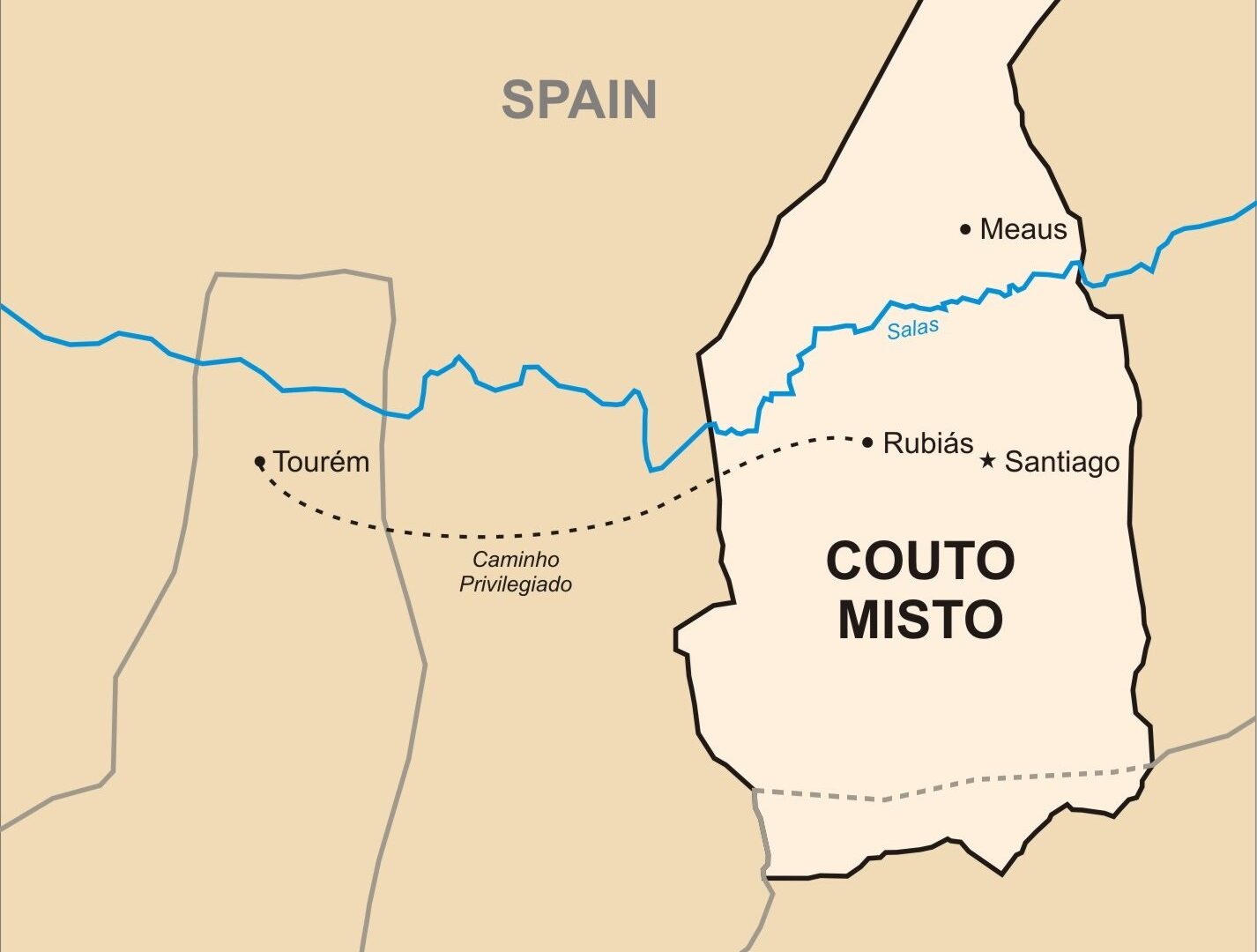
- Santiago, Rubiás and Meaus
- Area c. 1860
- 2,695 ha
- Population c. 1860
- about a thousand people
This page tells, following the article by Luís Manuel García Mañá, then vice-president of the Association of Friends of the Couto Mixto, how the Treaty of Limits that ended the Couto Mixto was carried out in 1868. The general history of the territory is in The Couto Mixto [1].
The Couto before the treaty
Around 1860 the three villages (Santiago, Rubiás and Meaus) totalled 2,695 hectares and about a thousand people [1]. The author notes that there are no documents proving the origin of the institution, but that it was born tied to the Piconha Castle and, in time, to the House of Braganza; from the late 15th century there was also a relationship with the House of Monterrei, and both took part in lawsuits and agreements [1].
The head of the Couto, with the title of "governing and political judge", was elected in an assembly of heads of household every three years and was assisted by two "men of agreement" per village and a "vicar of the month". In major lawsuits litigants could appeal to the Galician and Portuguese courts, of Xinzo and Montalegre; in criminal matters the judge heard cases under his own jurisdiction, but murderers were handed to the Spanish or Portuguese court according to their nature [1]. The agreements and privileges were kept in the three-key chest in the sacristy of the church of Santiago, the territory’s political capital [1].
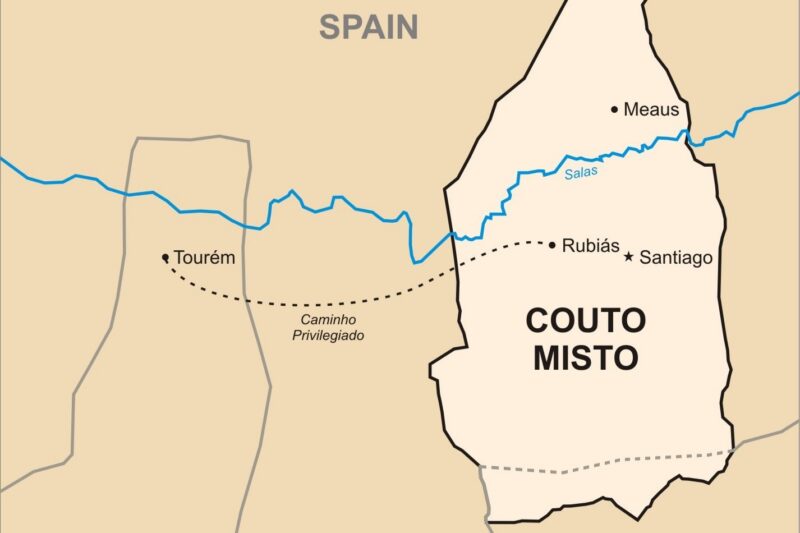
Among the privileges, the author cites the right of asylum, not giving soldiers, tax exemption, freedom of trade (including salt, a monopoly until 1868) and of crops such as tobacco. For trade they had a road immune from border-guard action that linked the Couto with Tourém, about six kilometres away, across Randín lands [1]. Ecclesiastically they depended on the diocese of Ourense and often asked for kinship dispensations to marry among themselves and not lose the advantages; on their wedding day they could choose nationality and carve a "P" or an "E" on the house, a practice abandoned to avoid abuse [1].
The treaty
On 29 September 1864 the Treaty of Limits was signed in Lisbon: Portugal renounced its rights over the Couto in favour of Spain and received the Spanish part of three villages called "promiscuous villages", further east along the border. The great architect of the negotiation was, according to the article, the diplomat Fidencio Bourman [1].
The Santiago ceremony (23 June 1868)
On 23 June 1868, in the churchyard of Santiago, a crowd gathered; the inhabitants of Santiago, Rubiás and Meaus watched without opposing. Public order was in the hands of Mariano Calbo, an officer of the Carabineros Corps stationed in Calvos de Randín [1]. The kingdoms were represented by Bernardo Antonio Díaz Pereira Magro, bachelor of Medicine and Surgery, of Tourém, for Portugal, and the lawyer Rafael Teijeiro for Spain, assisted by notaries and accompanied by the mayor of Calvos de Randín, Juan Manuel Tejada, and the administrator of the concello of Montalegre, Sebastião de Miranda Atahide Melo e Castro [1].
The commissioners exchanged powers and, in accordance with article 7 of the treaty, awarded the villages to Spain; the Portuguese representative made the handover and the Spanish one accepted "real, corporal and civil" possession, from that moment under the "dominion and sovereignty" of Spain. The record was drawn up in Castilian and Portuguese and signed by all present; afterwards a toast was drunk to the monarchs and there was a meal, while the inhabitants began to see their larders inspected by the Treasury [1].
The promiscuous villages
Four days later there was another ceremony in Soutelinho, this time in favour of Portugal: a whole territory was not being handed over, but the Spanish part of the villages of Soutelinho, Cambedo and Lamadarcos, where the border ran through the middle of the villages, even through houses, though it was never disputed on which side each building stood. A strip of land was added to move the houses away from the new line and the villages remained whole on Trás-os-Montes soil [1]. The legal ceremony followed article 11 of the treaty, with the same commissioners and secretaries (José Modesto Blanco for Spain and José Dias da Costa for Portugal) [1]. The inhabitants of Cambedo and Lamadarcos were separated from the neighbouring Galician villages where they had not needed permits to travel [1].
On 9 April 1869 the governor of Ourense ordered the "Spanish authorities" still in Soutelinho, Cambedo and Lamadarcos to be withdrawn, after a complaint from the Lisbon Government [1].
Links
Sources
- Luís Manuel García Mañá, «Couto Mixto, unha república esquecida», Tempo Exterior n.º 3 (segunda época), IGADI, xullo–decembro de 2001. http://www.igadi.org/arquivo/te_se03/couto_mixto_unha_republica_esquecida.htm