


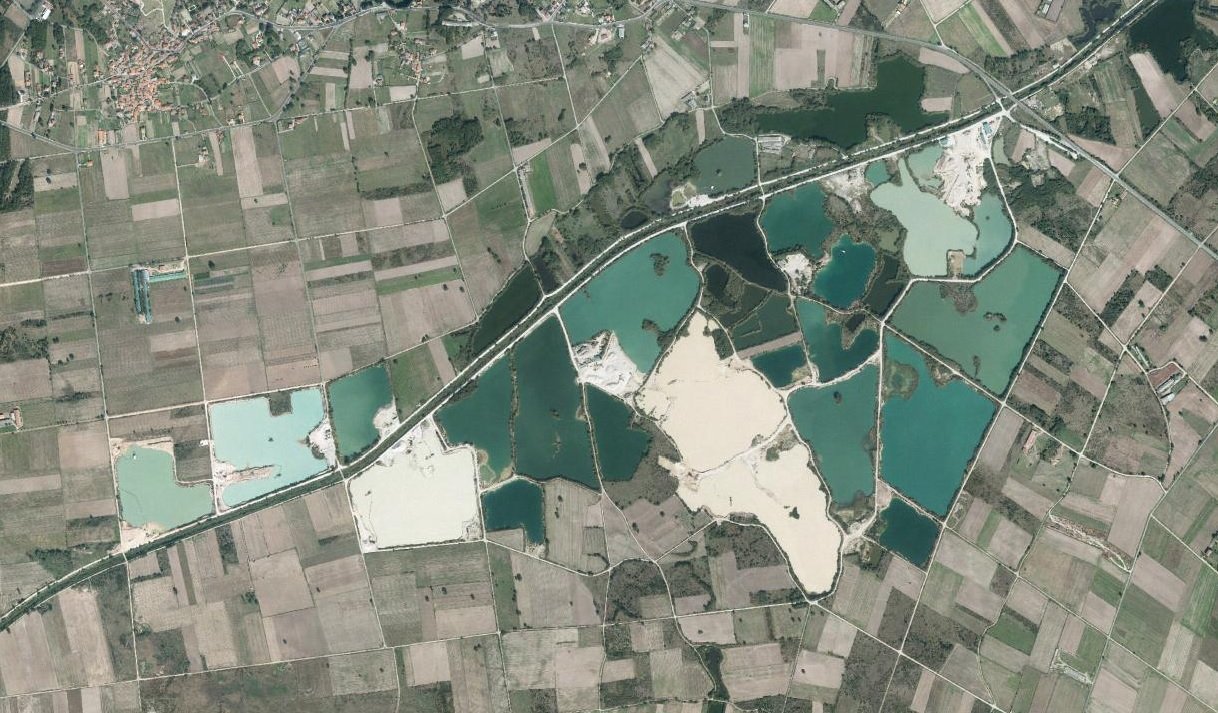
The Lagoa de Antela today: sand pits, Gomareite, Casa da Lagoa and restoration
What is left of the Lagoa de Antela: sand-pit ponds, the Veiga de Gomareite recovered by the SGHN, the Casa da Lagoa in Sandiás and the commitment to restore at least 500 hectares in the 2030 Strategic Wetlands Plan.
- Gomareite recovered
- 20.5 ha (Vilar de Barrio)
- Official commitment
- restore at least 500 ha under the 2030 Strategic Wetlands Plan
- Interpretation centre
- Casa da Lagoa (Sandiás)
- Organisations
- SGHN, SGO and SEO/BirdLife
The Lagoa de Antela today does not exist as a lake, but A Limia keeps remnants of water and life that can be visited and that support a growing movement to recover part of the wetland. This page records what remains, who is recovering it and where the restoration proposal stands.
The Sandiás sand pits: ponds by accident
Since 1972 sand workings have been opened in Sandiás and Xinzo de Limia in the area of the old lagoon; many of the small lagoons that resulted were abandoned when extraction ended [4][5]. The Environment Department began a biodiversity recovery project, and a sign in the area thanks the cooperation of the local industrialists: many abandoned sand pits now show a biological richness similar to that of a corner of the vanished lagoon [4]. The website xinzodelimia.eu photographed 16 species at the ponds, among them the grey heron, the white stork, the little grebe, the great crested grebe and the green frog [6] (see Ponds and birds of the Lagoa de Antela).
On the guided visit of February 2025 three places were described: the "Poza das Conícoras", a sand-pit pond between Vilar de Santos and Sandiás subject to a land stewardship agreement; bird observatory 2 of the Sandiás Sand Pits or "Casa dos Terróns", a name alluding to the "felpas" (turfs) made of earth and bión roots; and the Veiga de Gomareite [2].
The Veiga de Gomareite
In Vilar de Barrio, in the north-north-east of the old water sheet, the Sociedade Galega de Historia Natural (SGHN) has been recovering since 2014, under an agreement with a local extensive cattle farmer, 20.5 hectares of meadow as a temporary wetland; the work is being extended to another 5 neighbouring hectares [1]. According to the Greenpeace dossier, the intervention protects around 25 % of the world population of the thistle Eryngium viviparum and a third of the Galician breeding population of lapwing, and gives rest and food to some thirty species of migratory water birds [1]. The 2025 El País report presents this recovery as being in part the work of a local farmer’s cows [7].
The Casa da Lagoa
In 2008, when fifty years had passed since the start of the drainage works, Sandiás Town Council opened the Casa da Lagoa (Lagoa de Antela Interpretation Centre), which traces the formation of the lagoon, its drying and the environmental recovery of the former sand pits [5]. It is at Praza de Dona Irene, 2, in Sandiás (Santo Estevo) [8], and is where the 2025 conferences on the lagoon were held [2][3]. A popularising blog on Galicia Máxica places the sand pits in the south of the old lagoon since 1972 and estimates they covered about 250 hectares, many of them now abandoned [9].
The commitment to restore 500 hectares
In February 2021, the Minister for Ecological Transition announced the intention to partially restore Antela, La Nava and La Janda, the lagoons drained under Franco; in December 2022 the BOE published the Strategic Wetlands Plan to 2030, which includes restoring at least 500 hectares of the Lagoa de Antela and its surroundings [2]. SEO/BirdLife demanded in February 2025 that preparatory work begin [2]. In November 2025, the conference "Redescubrir Antela: a memoria e o futuro do gran humidal galego" concluded that the original area should be restored as far as possible, in a coordinated and participatory way, and regretted the Ministry’s delay [3].
On feasibility, the paper by Diego Rodríguez Vieites (Sociedade Galega de Ornitoloxía) maintains that the lagoon could be restored in just one year; the benefits would go to nature and local communities, with jobs in extensive livestock farming and green tourism, and the farmers of the land to be recovered could be compensated or relocated to other plots [2]. An earlier attempt at partial restoration, in 2001, sought the umbrella of UNESCO’s MAB programme and failed before a plan was drafted [1]. This is a position of the conservation organisations; the testimonies of some neighbours, who see the draining as beneficial, are in Memory and testimonies.
Fire in the peat bogs (2017)
In the surroundings of the old lagoon there was a fire in March 2017 whose fire kept burning underground in the peat bogs eleven months later; the association Amigos das Árbores da Limia demanded that it be put out, because when peat bogs burn they lose their capacity to hold water and stop feeding the streams, and when they dry they release CO₂ [11].
A commitment for three lagoons
Antela was, according to Ecoticias, among the three largest inland lagoons of the peninsula, along with La Janda (Cádiz) and La Nava (Palencia), and all three were drained in the 20th century for intensive agriculture. The Ministry for Ecological Transition announced in 2021 the commitment to restore them; Ecoticias reports that about 20 hectares were recovered at Antela and almost 400 at La Nava, while at La Janda progress is minimal [12].
What to see and how to get there
The easiest places to visit are the Casa da Lagoa, in Sandiás, and the sand pits, with bird observatories [2][5]. For the history, see The draining of the Lagoa de Antela.
Links
- The SGHN Antela Section
- Lagoa de Antela
- The original lagoon
- Sandiás
- Vilar de Barrio
- Protected areas of A Limia
Sources
- Greenpeace España, dossier «Tres lagunas», marzo de 2026. https://es.greenpeace.org/es/wp-content/uploads/sites/3/2026/03/dossier-tres-lagunas_.pdf
- Vía Lethes, «SEO/BirdLife reivindica en Sandiás a restauración da Lagoa de Antela», 04-02-2025. https://vialethes.es/seo-birdlife-reivindica-sandias-restauracion-lagoa-antela
- Vía Lethes, «A sociedade civil demanda ás administracións a restauración da Lagoa de Antela», 02-12-2025. https://vialethes.es/sociedade-civil-demanda-administracions-restauracion-lagoa-antela
- lagoadeantela.es, «Intento de recuperación de la biodiversidad de la laguna de Antela». https://lagoadeantela.es/intento-de-recuperacion-de-la-biodiversidad-de-la-laguna-de-antela/
- «Lagoa de Antela», Galipedia (CC BY-SA 4.0). https://gl.wikipedia.org/wiki/Lagoa_de_Antela
- «Charcas da Lagoa de Antela», xinzodelimia.eu. http://www.xinzodelimia.eu:80/charcas_da_lagoa.htm
- El País, «Antela, la gran laguna excomulgada y aniquilada, recobra vida con ayuda de las vacas de Samuel», 14-09-2025. https://elpais.com/espana/galicia/2025-09-14/antela-la-gran-laguna-excomulgada-y-aniquilada-recobra-vida-con-ayuda-de-las-vacas-de-samuel.html — Wayback (09-08-2026): https://web.archive.org/web/20260809085817/https://elpais.com/espana/galicia/2025-09-14/antela-la-gran-laguna-excomulgada-y-aniquilada-recobra-vida-con-ayuda-de-las-vacas-de-samuel.html
- Turismo de Galicia, «Centro de Interpretación da Lagoa de Antela». http://www.turismo.gal/ficha-recurso?langId=gl_ES&cod_rec=280378378&ctre=1000181
- «La Laguna de Antela. El mayor humedal perdido de Galicia» (cita), Galicia Máxica (blog). https://blog.galiciamaxica.eu/la-laguna-de-antela-el-mayor-humedal-perdido-de-galicia/
- «Centro de Interpretación da Lagoa de Antela». https://web.archive.org/web/20161029044715/http://www.turismo.gal/ficha-recurso?langId=gl_ES&cod_rec=280378378&ctre=1000181
- Gciencia, «A Limia segue ardendo once meses despois dos incendios». https://gciencia.com/medioambiental/limia-turbeiras-incendios/
- Ecoticias, «El MITECO prometió restaurar 3 humedales ‘desecados’ por el franquismo, los avances son mínimos». https://www.ecoticias.com/medio-ambiente/miteco-humedales-desecados-franquismo
You may also like
 Lagoa de AntelaThe original lagoon: extent, canals, ponds, fauna and flora of the Lagoa de AntelaWhat the Lagoa de Antela was like before 1958: a shallow sheet of water 7 by 6 kilometres, with canals and ponds, water birds, leeches,…
Lagoa de AntelaThe draining of the Lagoa de Antela: from the 18th-century projects to the works of 1958A documented chronology of the attempts to drain the Lagoa de Antela: Toubes (1827), Pelayo Cuesta, the Mugártegui, Iscar, Stone and…
Lagoa de AntelaThe Lagoa de Antela in figures: area, water and habitatsSources give very different areas for the Lagoa de Antela, from 2,630 to 5,870 ha. This page gathers the estimates, the seasonal flooding…
Lagoa de AntelaThe 1956 Law and the drainage project of AntelaHow the Law of 27 December 1956 and Francisco Zapata Tejedor's project led to the draining of Antela: phases, works from 1958, the 1962…
Lagoa de AntelaLegislation on the Lagoa de Antela (1868–2002)Chronology of the rules of the Gaceta de Madrid, BOE and DOG on the draining of Antela: concessions from 1868 to 1907, the 1918 law, the…
Lagoa de AntelaThe leeches of the Lagoa de AntelaIn the 19th century the Lagoa de Antela was a leech breeding ground famous in Spain: a factory exported to France, catching ended up…
